For iPhone · Vitamin D & Sun Safety
The sun only makes vitamin D for part of the day.
Geddy — Safe UV dose & burn limit.
Geddy computes the sun's actual angle where you are, tells you exactly how long to stay out, and interrupts you before you burn — even through Focus.

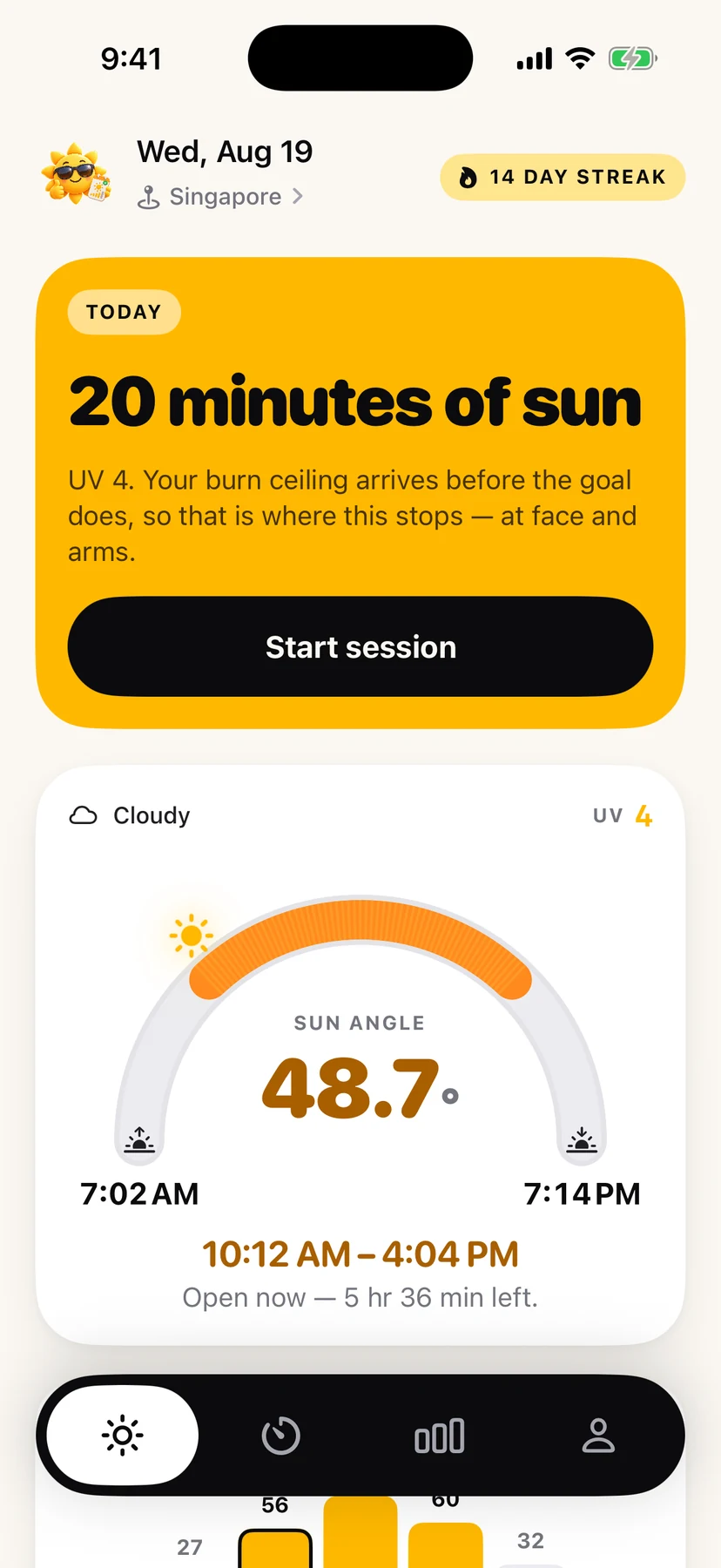
- The angle that matters
- 45°The angle that matters
- Number on the Today screen
- 1Number on the Today screen
- Yours, synced privately
- iCloudYours, synced privately
- Accounts or analytics
- 0Accounts or analytics
The sun only makes vitamin D for part of the day, and at some latitudes it stops for months. Geddy tells you when that window is open where you are, how long to stay in it, and when to cover up.
It is built for people who already track sleep and training load — and it is honest about the limits of what it can know.
Why Geddy is different
The sun's angle, not just the UV index
Below roughly 45 degrees of elevation, sunlight takes a long enough path through the atmosphere that most UVB is absorbed and vitamin D synthesis falls away sharply. A UV index alone will not tell you that. Geddy computes solar altitude for your coordinates and date — so it can say the window opens at 10:40, or that at your latitude in January it is not coming at all.
How long, and why that long
One number on the Today screen: the minutes to go out for. Underneath it, the reason — whether that figure came from your daily goal or from your burn ceiling. Those are different situations and they call for different decisions when the minutes are up.
The ceiling interrupts you
Every session carries a hard limit derived from the minimal erythemal dose for your skin type at the current UV index. Reach it and Geddy sends a time-sensitive notification that breaks through Focus — because the cost of that alert being silenced is a sunburn. It reschedules as the UV changes, always toward stopping sooner.
Three sessions in two weeks, then Geddy Pro
Your first three sessions are free, inside your first two weeks — three in total, not three a day, and whichever of the two runs out first is the one that stops you. After that, running a session is part of Geddy Pro: the timer, the burn ceiling and its alert, plus the scrubbable arc of the day, hour-by-hour UV and sun-angle charts, live readings and the almanac. Free forever, with no subscription: today's window and its hours, the minutes Geddy suggests for you, the current UV index and your estimated time to burn, and everything you have ever logged. Losing Pro never deletes anything.
Built to be read in direct sun
The session screen is the one dark screen in the app, with heavy numerals sized for a squint at arm's length. A Live Activity on your Lock Screen and in the Dynamic Island carries elapsed time, accumulated dose and time remaining, so you can check without unlocking.
Your skin, not an average one
The estimate uses your Fitzpatrick phototype, your age, and how much skin you have exposed — set per session, because a t-shirt and a swimsuit are not the same input, and coverage swings the result more than almost anything else.
Your blood work is the ground truth
Record your serum 25(OH)D results and chart them against months of estimated intake. This is the loop the app is built around: the estimate is a hypothesis, your lab result is the measurement. Let it correct the model.
A log worth keeping
Every session with its duration, estimated IU and bounds, the UV it ran under, and where it was. Totals by day and week, goal attainment, your streak, and sub-threshold sessions kept separate from the ones that counted.
Health it writes to, and never reads
Sessions are written to Apple Health as Time in Daylight, so your exposure joins the rest of your record. The permission sheet carries a single row: write. Geddy requests no read access of any kind — you type your age in yourself. Save the places you travel back to and switch between them in a tap.
Honest about what it knows
The dose figure is a model output, and Geddy marks it provisional wherever it appears. It shows bounds, not one confident number. When the weather service cannot be reached it says so rather than inventing a UV index — the solar geometry is computed on your device and stays correct either way.
Private by default
No account and no analytics: nothing in Geddy reports which screens you open or how often you open it. There is one advert — a card near the bottom of the Profile screen showing another independent developer's app, through Kickstart Exchange. It is a swap rather than a sale, it is not targeted at you, and Kickstart is told only that the card appeared and whether you tapped it. Your sessions, dose history and blood results sync through your own iCloud, so they reach your other devices and survive a lost phone — to Apple, on your behalf, never to us. We run no server, hold no copy, and cannot read yours. You can set your position by hand and never grant location access at all; otherwise your coordinates go to Apple's weather service for the UV index, and nowhere else.
Your history follows you
Change your phone and sign back in: every session, blood result, goal and streak is already there. Sync is a mirror rather than a backup, though — a deletion travels to your other devices too — so keep an encrypted device backup and your own record of lab results.
Who it is for
Northern winters
Find out honestly that the window is closed where you live, instead of standing outside in February for nothing.
Fair skin, strong sun
A hard burn ceiling per session, computed from your phototype and the live UV index, with an alert that cuts through Focus.
Tracking a deficiency
Log your blood results and watch them against months of estimated intake to see whether your routine is actually working.
Travel
Save the places you return to and switch between them in a tap — the window and the ceiling both move with the latitude.
Questions, answered.
Why does the sun's angle matter more than the UV index?
Below roughly 45 degrees of solar elevation, most UVB is absorbed by the atmosphere before it reaches you and vitamin D synthesis falls away sharply — while the UV index can still look meaningful. Geddy computes the angle for your exact coordinates and date.
Will it warn me before I burn?
Yes. Each session carries a ceiling derived from the minimal erythemal dose for your skin type at the current UV index, and the alert is time-sensitive so it breaks through Focus. It reschedules as the UV changes, always toward stopping sooner.
What does it cost?
Geddy is free to download and your first three sessions are free, inside your first two weeks — three in total, not three a day, and whichever runs out first is the one that stops you. Both limits are recorded in your own iCloud profile rather than on the handset, so reinstalling does not start them over. After that, running a session is part of Geddy Pro, an auto-renewing subscription. Today's window, the minutes suggested for you, the current UV index, your estimated time to burn and everything you have ever logged stay free for as long as you use the app. Prices and any trial are shown on the purchase screen before you confirm.
Do I have to share my location?
No. You can set your position by hand and never grant location access — it is a fully supported path. If you do grant it, your coordinates go to Apple's weather service for the UV index and nowhere else.
Does my history sync between devices?
Yes, through your own private iCloud database — to Apple on your behalf, never to us. We run no server and hold no copy. You can switch sync off in iOS Settings and the app works exactly the same. Note that sync is a mirror rather than a backup: a deletion travels to your other devices too.
What does Geddy read from Apple Health?
Nothing. It writes your sessions to Health as Time in Daylight and requests no read access at all — the permission sheet has a single row. Earlier versions read your date of birth to save you typing; that was removed, and you now enter your age directly.
How accurate is the vitamin D estimate?
It is a model output, and Geddy marks it provisional everywhere it appears. It shows bounds rather than one confident number, and it is built so your own blood work can correct it over time.
Get the sun. Not the sunburn.
Geddy tells you when the window is open, how long to stay in it, and stops you before the cost outweighs the benefit.
Geddy is not a medical device and does not give medical advice. It estimates; it cannot see you. Never treat time remaining as permission to stay out — and never treat an app that has stopped counting as one either. Nothing about the sun changes when your free sessions run out, or when your first two weeks are up. Talk to a doctor first if you have a history of skin cancer, a photosensitivity condition, or take medication that increases sun sensitivity. Weather data provided by Apple Weather.